
The Challenge
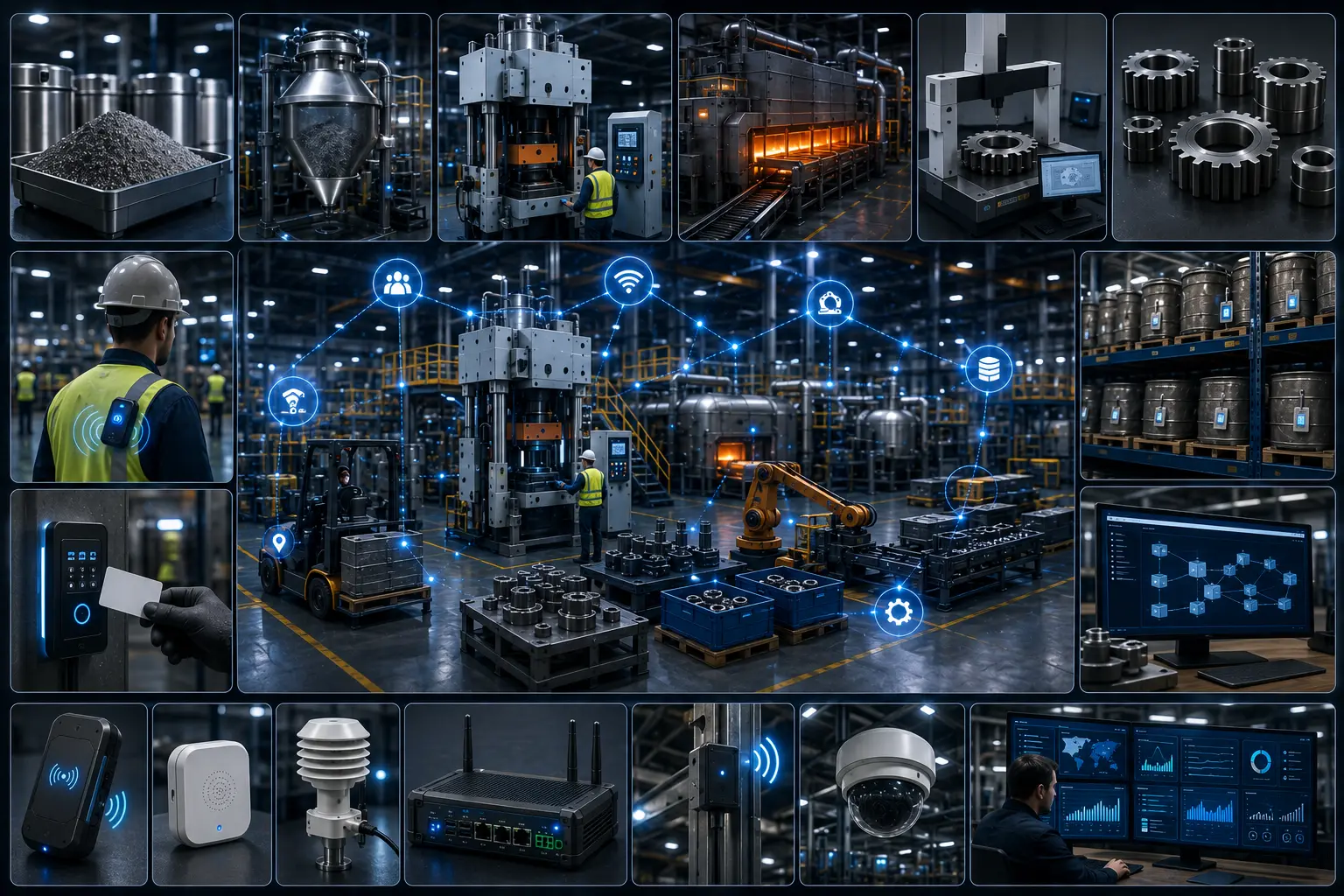
Powder metallurgy manufacturing combines material science, precision engineering, compaction technologies, thermal processing, tooling management, and quality control to produce complex metal components efficiently and consistently. Facilities must manage metal powders, blending operations, compaction presses, dies, sintering furnaces, material certifications, environmental safety requirements, and production traceability while maintaining operational efficiency.
The Solution
PowderForge AI applies artificial intelligence, RFID, Bluetooth Low Energy, LoRaWAN, industrial sensors, edge computing, and operational analytics throughout powder metallurgy production environments. These technologies provide visibility into workforce activities, controlled access to sensitive production areas, tooling utilization, powder inventory management, work-in-progress movement, and lot genealogy.
Real-World Applications
The following applications demonstrate how AIoT technologies support real-world powder metallurgy manufacturing operations across powder preparation, blending, workforce visibility, access governance, compaction, tooling, inventory, WIP, sintering, safety, quality, certification, and enterprise visibility.
Practical AIoT Deployments Across Powder Metallurgy Operations
Powder Preparation Operations
Powder preparation represents the foundation of the powder metallurgy process. Material quality, storage conditions, and inventory accuracy directly influence compaction performance, sintering behavior, and final product quality. AIoT technologies improve visibility throughout powder receiving and storage activities.
Applications Include
- RFID powder container identification
- Lot tracking automation
- Material receiving verification
- Warehouse inventory visibility
- Powder storage monitoring
- Material movement tracking
- Inventory reconciliation
- Consumption analytics
RFID-enabled material identification reduces manual data entry while improving inventory accuracy. AI analytics evaluate historical consumption patterns and forecast future powder requirements based on production schedules and demand trends. Operational teams gain visibility into material availability before production orders begin.
Powder Blending Operations
Powder blending directly affects density consistency, compressibility, dimensional stability, and final metallurgical properties. Manufacturers frequently manage multiple powder grades, alloy compositions, lubricants, and additives that must be blended according to specific process requirements.
AIoT Systems Support Blending Through
- Lot verification
- Material identification
- Blend traceability
- Batch tracking
- Production routing
- Inventory synchronization
- Material genealogy management
RFID technology helps verify that correct material lots are assigned to blending operations. AI-powered analytics identify material consumption patterns and support production planning. Quality teams benefit from improved traceability linking finished components back to source powders and blending records.
Workforce Visibility Applications
Workforce visibility remains one of the most important operational applications within powder metallurgy facilities. Employees frequently move among powder handling zones, blending areas, compaction presses, furnace operations, maintenance departments, laboratories, and shipping facilities. BLE and RFID technologies provide real-time workforce intelligence.
Applications Include
- Worker location visibility
- Occupancy monitoring
- Emergency accountability
- Contractor management
- Safety zone monitoring
- Evacuation verification
- Shift activity reporting
- Workforce utilization analysis
BLE safety badges enable organizations to understand personnel locations while supporting emergency response procedures. Operational leaders gain greater visibility into workforce distribution across production areas.
Access Governance Applications
Controlled access is critical in powder metallurgy environments where production assets, furnace systems, tooling inventories, and hazardous materials require authorization controls. AI-enabled access management systems support:
- Production zone access
- Furnace access control
- Tool room authorization
- Maintenance access validation
- Contractor credential management
- Safety compliance verification
- Restricted area monitoring
RFID credentials and BLE-based authorization systems help ensure that only qualified personnel access designated locations. Access events can be integrated with production records, maintenance systems, and compliance reporting applications.
Compaction Press Operations
Compaction presses serve as the primary production equipment within powder metallurgy manufacturing. Production performance depends on consistent press operation, tooling condition, material quality, and process stability. AIoT applications support compaction environments through:
- Press utilization monitoring
- Equipment performance analysis
- Production throughput monitoring
- Tool change verification
- Process condition monitoring
- Operational reporting
- Workforce coordination
Industrial sensors continuously monitor operating conditions while analytics systems evaluate production performance trends. Real-time visibility allows operations personnel to identify performance deviations before they affect production output.
Tooling Management Applications
Tooling assets represent significant investments within powder metallurgy facilities. Dies, punches, core rods, inserts, and precision tooling components require careful management throughout their operational lifecycle. RFID-enabled tooling intelligence supports:
- Tool identification
- Tool location visibility
- Utilization monitoring
- Maintenance scheduling
- Lifecycle management
- Tool availability reporting
- Asset tracking
AI-powered analytics evaluate usage history and maintenance trends to support maintenance planning. Organizations gain improved visibility into tooling availability, reducing production delays associated with misplaced or unavailable assets.
Powder Inventory Optimization
Inventory management remains a major operational challenge for manufacturers handling multiple metal powder grades and material specifications. AIoT technologies provide real-time inventory intelligence.
Applications Include
- Powder lot tracking
- Inventory visibility
- Stock forecasting
- Consumption analysis
- Reorder optimization
- Material allocation
- Multi-location inventory management
RFID systems continuously update inventory records as materials move throughout production facilities. Artificial intelligence models analyze historical consumption patterns and production schedules to improve inventory planning. Benefits include reduced stockouts, improved inventory accuracy, and better procurement decisions.
Work-in-Progress Visibility
Work-in-progress monitoring supports visibility between compaction, staging, sintering, secondary operations, inspection, and packaging. Many manufacturers struggle to maintain visibility as components move among production stages. AIoT systems provide:
- WIP location tracking
- Production routing visibility
- Queue monitoring
- Throughput analysis
- Bottleneck identification
- Process flow analytics
RFID tracking enables organizations to monitor component movement throughout manufacturing operations. AI analytics evaluate production flow performance and identify opportunities for process improvement.
Sintering Furnace Operations
Sintering is one of the most critical production stages within powder metallurgy manufacturing. Thermal processing directly influences density, dimensional stability, mechanical properties, and metallurgical characteristics. AIoT applications support:
- Furnace utilization monitoring
- Batch tracking
- Process visibility
- Thermal cycle association
- Production scheduling
- Throughput analytics
- Traceability integration
Operational information from furnace systems can be associated with production records and genealogy databases. This creates a more complete manufacturing history for each production lot.
Dust Safety Monitoring
Metal powder environments require strong safety controls due to combustible dust risks and airborne particulate exposure. Industrial IoT sensors provide continuous environmental visibility.
Applications Include
- Air quality monitoring
- Dust concentration measurement
- Exposure monitoring
- Environmental reporting
- Hazard notification
- Safety analytics
BLE-enabled alerting systems can notify personnel when environmental conditions require attention. Organizations improve visibility into workplace conditions while supporting safety compliance initiatives.
Quality Control Applications
Quality management relies on accurate production records, material genealogy, process visibility, and operational consistency. AIoT technologies strengthen quality programs by connecting production information across manufacturing stages.
Applications Include
- Process traceability
- Production history visibility
- Quality record association
- Statistical analysis
- Inspection reporting
- Defect investigation support
Artificial intelligence can identify patterns associated with recurring quality issues and process deviations. Quality teams gain faster access to production information during investigations and audits.
Material Certification Management
Many powder metallurgy manufacturers support industries requiring extensive documentation and certification records. Material certification management applications include:
- Raw material verification
- Lot genealogy tracking
- Process documentation
- Production history records
- Compliance reporting
- Audit preparation
RFID-enabled traceability systems help maintain connections among source powders, production batches, furnace cycles, inspection records, and finished components. Documentation becomes more accessible and easier to retrieve during audits or customer inquiries.
Integrated Views Across Workforce, Production, Inventory, and Assets
Enterprise visibility extends beyond individual production areas. Organizations require integrated views of workforce activities, production performance, inventory status, tooling utilization, and operational efficiency. AIoT dashboards provide:
- Production monitoring
- Inventory visibility
- Workforce analytics
- Asset utilization reporting
- Operational KPIs
- Multi-site reporting
- Management dashboards
Decision-makers gain access to information that supports strategic planning and operational improvements.
Visibility, Consistency, Traceability, and Data-Driven Decision-Making
Operational excellence in powder metallurgy depends on visibility, consistency, traceability, and data-driven decision-making. Rather than relying solely on manual reporting, manufacturers can leverage automated data collection and analytics to support continuous improvement initiatives. AIoT technologies help organizations improve:
- Workforce accountability
- Access governance
- Tooling utilization
- Inventory accuracy
- Production flow efficiency
- Safety monitoring
- Quality management
- Traceability performance
Technologies Specifically Suited for Powder Metallurgy Environments
PowderForge AI solutions incorporate technologies specifically suited for powder metallurgy environments. These technologies operate together to create connected manufacturing environments capable of supporting workforce visibility, asset intelligence, inventory optimization, work-in-progress monitoring, and genealogy tracking.
Core Technologies Include
Decades of Industrial IoT, RFID, Wireless Networking, and Enterprise Integration Experience
PowderForge AI was developed within Aperture Venture Studio with support from GAO. The system benefits from decades of Industrial IoT, RFID, wireless networking, industrial automation, and enterprise integration experience accumulated across thousands of customer deployments and technology projects.
Engineering teams, researchers, industry specialists, and technical experts contribute expertise in RFID systems, BLE technologies, LoRaWAN infrastructure, manufacturing analytics, industrial networking, cloud systems, edge computing, and operational intelligence systems. Extensive experience supporting large enterprises, research organizations, universities, and government agencies helps guide solution design for complex manufacturing environments.